Research Progress
Connection between polycomb repression and cotranscriptional processing
On September 14, 2026, a research article titled Dynamic Polycomb–CBC crosstalk orchestrates mRNA production at transcriptionally active loci in plants by the research team led by Zicong Li at Shandong University and Fangqing Zhao at the Institute of Zoology, Chinese Academy of Sciences was published online in PNAS. Combining molecular‑biological and genomic approaches, this study reveals the molecular mechanism by which Polycomb group proteins repress transcriptionally active loci in the model plant Arabidopsis thaliana via binding to nascent pre‑mRNA. This work reports the interaction between the chromodomain H3K27me3 readers and pre‑mRNA and elucidates the epigenetic mechanism whereby PcG proteins regulate transcriptionally active genomic loci.
mRNA transcription is intricately associated with chromatin modification, RNAPII activity, and co-transcriptional mRNA processing. Active histone modifications and co-transcriptional mRNA processing are generally linked to productive transcription, whereas chromatin regions decorated by repressive modifications are perceived as pessimistic to being transcribed. H3K27me3 is a well-recognized transcriptionally repressive mark. H3K27me3 is catalyzed by PRC2 and interpreted by the reader-effector modules of PRC1 to mediate gene silencing. The chromodomain readers harbor a middle lysine and arginine -rich intrinsically disordered region, which can interact with single-stranded RNA through the positively charged IDR in vitro in model plant Arabidopsis thaliana.
In this study, it is demonstrated that LHP1 associates with nascent pre‑mRNA at transcriptionally active protein‑coding genes in an H3K27me3‑dependent manner, via its middle IDR. The interaction is released by the mRNA cap-binding complex for productive mRNA transcription. It is shown that the dynamic interplay between the H3K27me3 reader-effector module and CBC complex precisely modulates the expression level of WUSCHEL (WUS), a key homeotic gene for stem cell maintenance in shoot apical meristem (SAM) region.
At genome-wide, 2,345 mRNA transcripts are identified as LHP1 pre-mRNA targets and the interactions are released by CBC complex at transcriptionally active loci. While, using the ChIP-seq analysis, it is revealed that the overall LHP1 localization is not affected by the competition between LHP1 and CBP20, and the removal of Polycomb group proteins is not essential for mRNA transcription at transcriptionally active loci across Arabidopsis genome.
Overall, LHP1 binds over 2,000 mRNA transcripts and this protein-mRNA association downregulates mRNA production. This inhibition is subsequently antagonized by co-transcriptional mRNA capping, which facilitates the release of nascent pre-mRNA for productive transcription (Fig 2). Thus, this study illustrates a ternary-interconnected machinery linking chromatin state, transcription, and mRNA processing for gene regulation and proper development in plants.
This study is supported by fundings from the National Natural Science Foundation of China (grant no. 32570689, no. 32370621, and no. 31970533 to Z.L., and grant no. 32025009 and no. 32130020 to F.Z.), the Natural Science Foundation of Shandong Province (grant no. ZR2021JQ10 to Z.L.).
DOI: https://doi.org/10.1073/pnas.2607481123
Contact:
ZHAO Fangqing
Institute of Zoology, Chinese Academy of Sciences
Tel: 86-10-84504172
E-mail: zhfq@ioz.ac.cn
Web:http://english.ioz.cas.cn/
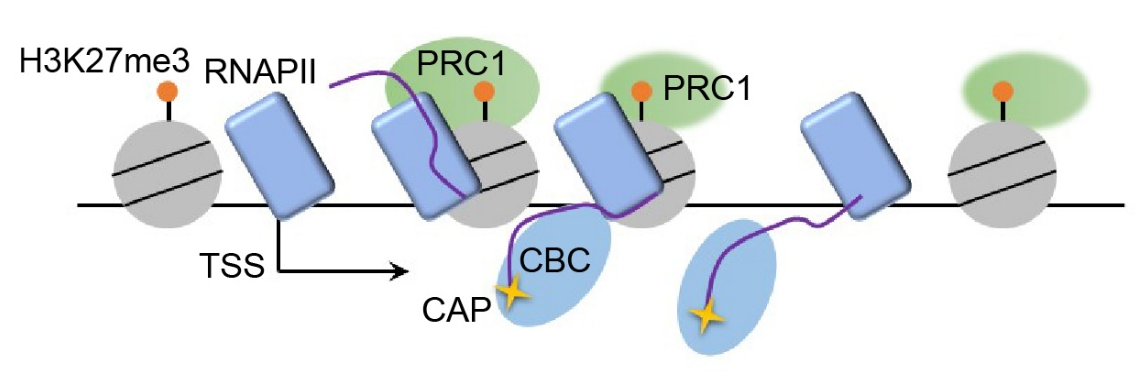
polycomb repression and cotranscriptional processing
(image by ZHAO Fangqing’s Lab)