News
Luigi Fiorentino, President of Italy's National Center for the Future of Biodiversity, and his delegation visited the Institute of Zoology of the Chinese Academy of Sciences
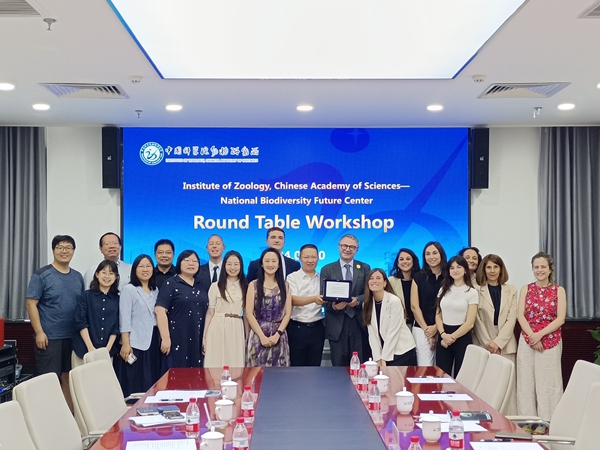
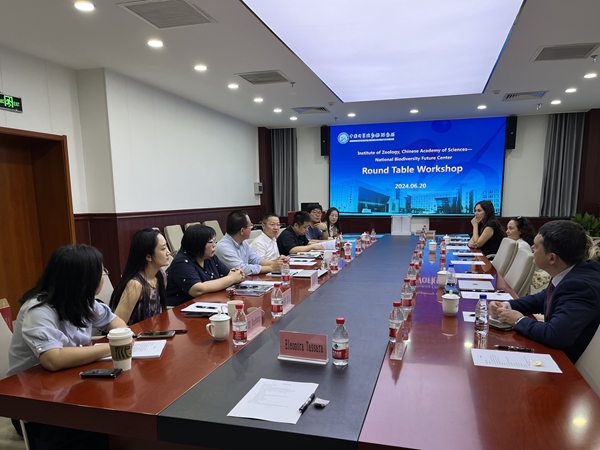
On June 20, 2024, a delegation of 10 people, including Luigi Fiorentino, President of the National Biodiversity Future Center (hereinafter referred to as NBFC), Ms. MelissaRIDOLFI, Chief Financial Officer, Professor Isabella SAGGIO, Chief Scientist of NBFC, and Mr. Jean Paul de JORIO, Chief Legal Officer of NBFC, visited the Institute of Zoology of the Chinese Academy of Sciences (hereinafter referred to as the "Institute of Zoology"). The two sides held a round table forum on the future development and cooperation in the field of biodiversity, and carried out in-depth academic discussions and exchanges.
Zhan Xiangjiang, the deputy director of the Institute of Zoology, Wang Xilu, the European Office of the Bureau of International Cooperation of the Chinese Academy of Sciences, Xu Xuehong, the director of the Office of the Biodiversity Committee of the Chinese Academy of Sciences, Bai Ming, Guo Baocheng, the researcher of the Institute of Zoology, Zhang Jie, the associate researcher, Zhu Pingfen, the assistant researcher, Li Meng, and Zhang Jiahui, the research and strategic planning office of the Institute, attended the symposium.
At the symposium, Zhan Xiangjiang warmly welcomed the arrival of the NBFC delegation on behalf of the Institute of Zoology. He reviewed the exchanges and visits between NBFC and the Institute of Zoology in November 2023 and March 2024, and introduced the historical evolution, disciplinary layout, and research direction of the Institute. He emphasized that the Institute of Zoology is a leader in biodiversity research in China, and biodiversity research is also the foundation of the Institute of Zoology. He hoped that both sides could carry out long-term cooperation in this field. Subsequently, Jean Paul, Chief Legal Officer of NBFC, delivered a speech expressing gratitude for the warm reception of the Animal Research Institute. He briefly introduced NBFC's structure, goals, scope of work, and expressed his hope to visit and exchange ideas again next year.
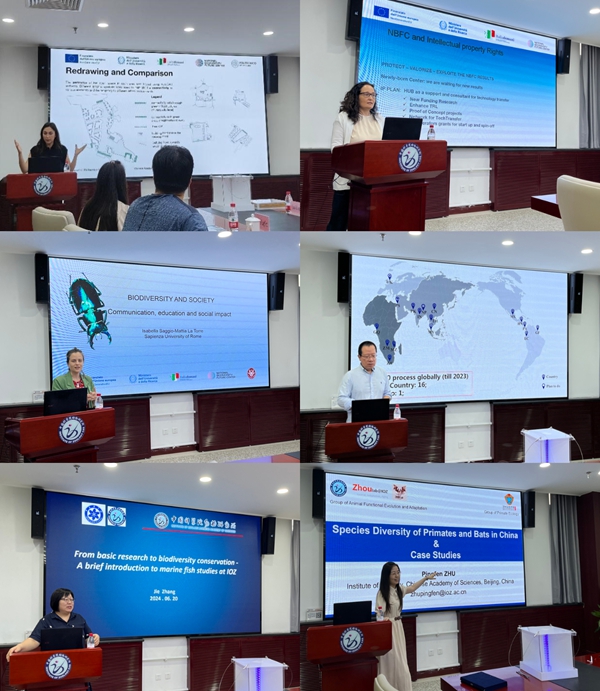
Next, personnel from both China and Italy gave academic presentations and engaged in lively discussions. Italian expert Director Alessia Naso introduced the overview and future development goals of NBFC; Assistant Professor Francesca Zanotto introduced the scientific assessment and quantification of urban biodiversity; Dr. Mattia La Torre introduced NBFC's projects on the integration of biodiversity with social exchange, education, and communication. Researcher Bai Ming from the Institute of Zoology introduced the characteristics and advantages of the new passive diversity monitoring equipment and the new AI network PENet, as well as the goals and tasks of the SITE-100 International Science Program, and suggested establishing a SITE-100 site in Italy; Associate Researcher Zhang Jie presented the investigation and research on the diversity conservation and adaptive evolution of cartilaginous and bony fish species in China's land and Southern Ocean, particularly in the 36th Chinese Antarctic Scientific Expedition, where she completed a survey of mid-level fish species in the Southern Ocean at a depth of 1000 meters; Associate Researcher Zhu Pingfen conducted research on genetic variations in animals adapting to extreme environments, evolutionary adaptations of animal lifespan, and host characteristics of epidemic source animals.
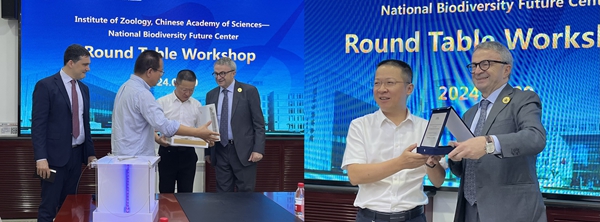
After the exchange and discussion, both sides exchanged commemorative gifts. The Italian side presented the first NBFC yearbook and commemorative ornaments for cooperation, while our side presented the newly developed insect diversity monitoring patent product by Researcher Bai Ming - a portable low beam light lure device, and explained its usage and principle.
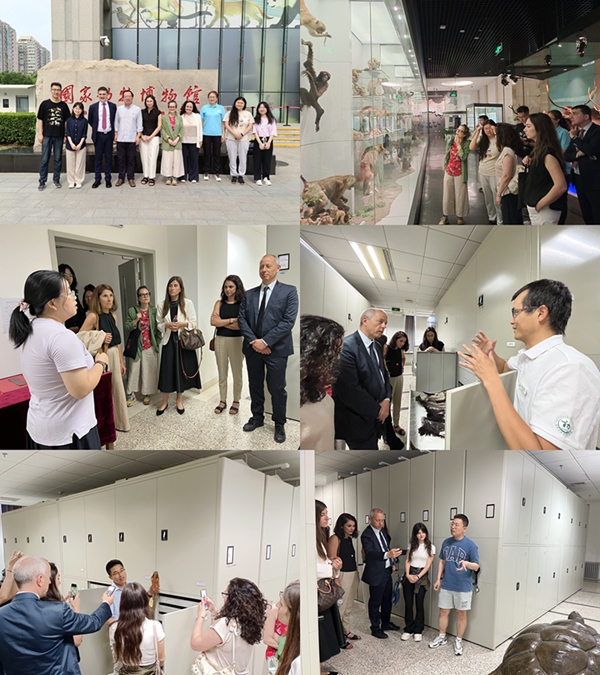
On that day, the NBFC delegation visited the National Museum of Zoology and the National Animal Specimen Resource Bank. Dr. Li Liu and Dr. Su Liang, librarians of the National Museum of Zoology, received the NBFC delegation and provided a detailed explanation of the collection areas, species information, population status, and conservation measures of animal specimens in the museum's collection. Dr. Zhang Kuiyan, He Peng, Zhu Xichao, and Dr. Wang Yingnan, administrators of the National Animal Specimen Resource Bank Branch, successively introduced the origins and production processes of rare specimens of insects, birds, mammals, and fish, as well as some specimens. The delegation expressed admiration for this and further understood the profound historical accumulation of the Institute of Zoology.
Introduction to the Background of Sino Italian Biodiversity Cooperation
China and Italy are both global hotspots for biodiversity, with Italy having the highest biodiversity in Europe and being the first country in the world to incorporate biodiversity into its constitution. In recent years, Italy has established a national research institution that oversees biodiversity related research resources throughout the country: the National Biodiversity Future Center (NBFC). China attaches great importance to the construction of ecological civilization and the protection of biodiversity. After several rounds of bilateral exchanges between the Chinese Academy of Sciences and the Italian National Center for the Future of Biodiversity, including November 19-22, 2023, the Italian biodiversity delegation will visit the Chinese Academy of Sciences for the first time, and Academician Enrico Alleva of the Italian Academy of Linqin Sciences was invited to make a brilliant academic report at the Institute of Zoology; On March 26, 2024, representatives from the Institute of Zoology participated in the first China Italy Biodiversity Conference held in Rome. Mainstream media such as Xinhua News Agency and Guangming Daily reported on the above-mentioned conference.
On June 19, 2024, the Chinese Academy of Sciences and NBFC signed the Memorandum of Understanding on Cooperation between the Chinese Academy of Sciences and the Italian National Center for the Future of Biodiversity. This visit is an important step in deepening cooperation between China and Italy in the field of biodiversity. In the future, close cooperation will continue in high-level visits, academic exchanges, and joint projects. Both sides look forward to jointly promoting the development of global biodiversity conservation, which will promote the progress of science and technology in both countries, and have a positive impact and contribution to addressing global common challenges, achieving the United Nations Sustainable Development Goals, and effectively protecting the global ecological environment.
Attachment: Some relevant news reports:
http://www.xinhuanet.com/20240327/810fec28549346eb992590a6d1a5336f/c.html
https://www.cas.cn/sygz/202406/t20240619_5022125.shtml
http://en.people.cn/n3/2024/0327/c90000-20149653.html
http://www.ioz.cas.cn/gb2018/xwdt/yw/202311/t20231124_6937517.html