Research Progress
Researchers Reveal m6A Epigenetic Modification Controls Arbovirus Infection and Transmission Between Vertebrates and Mosquitoes
Arthropod-borne viruses (arboviruses), such as dengue and Zika viruses, transmit widely across the globe, posing threats to human health and biosecurity. They spread through the bites of arthropod vectors, moving between insects and vertebrate hosts. To sustain their transmission cycle, these viruses must alternately infect both mosquito vectors and vertebrate hosts.
In a study published in PNAS, a research team led by Prof. ZHENG Aihua from the Institute of Zoology (IOZ), Chinese Academy of Sciences, revealed that N6-methyladenosine (m6A) epigenetic modifications in mosquito-borne flaviviruses (MBFs) enhance viral propagation in vertebrates and thus increase transmission from vertebrates to mosquitoes.
The m6A modification is the most prevalent post-transcriptional RNA modification in eukaryotes and plays a key role in regulating RNA stability and translation. Using cell culture systems, the researchers discovered that this modification preferentially enhanced flavivirus propagation in vertebrate cells but not in mosquito cells.
To further evaluate the role of m6A in vivo, the researchers inhibited m6A methylation using the methyltransferase inhibitor STM2457. This led to a significant reduction in viremia, along with less weight loss and decreased mortality in virus-infected mice. The treatment almost completely blocked the transmission of the virus from vertebrate hosts to mosquito vectors. These findings demonstrate, through loss-of-function evidence, that m6A modification directly contributes to viral replication and transmission in vivo.
Mechanistically, researchers found that the stem-loop I (SLI) structure in the viral 3′ untranslated region was required for regulating m6A modification in vertebrate cells. The SLI structure interacted with the host protein G3BP1, facilitating the formation of stress granules and thereby promoting m6A methylation of the viral RNA genome. This regulatory pathway was specific to vertebrate cells and did not affect m6A modification in mosquito-derived cells, suggesting a host-dependent regulatory mechanism.
This study provides in-depth mechanistic detail that improves understanding of the critical role of epigenetic modifications in flavivirus replication. It has significant implications for flavivirology, epigenetics, and public health, as well as for the development of novel strategies to block flaviviral transmission.
https://doi.org/10.1073/pnas.2511164123
Contact:
ZHENG Aihua
Institute of Zoology, Chinese Academy of Sciences
Tel: 86-10-64807178
E-mail: zhengaihua@ioz.ac.cn
Web:http://english.ioz.cas.cn/
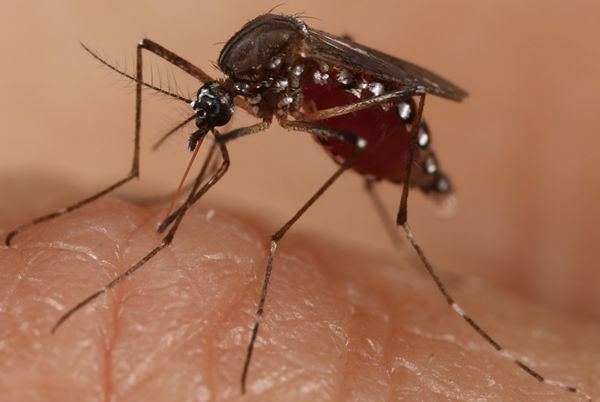
Pictured is a blood-feeding Aedes aegypti, the primary vector for the dengue and Zika viruses. (Image by ZHENG Aihua’s Lab)