Research Stories
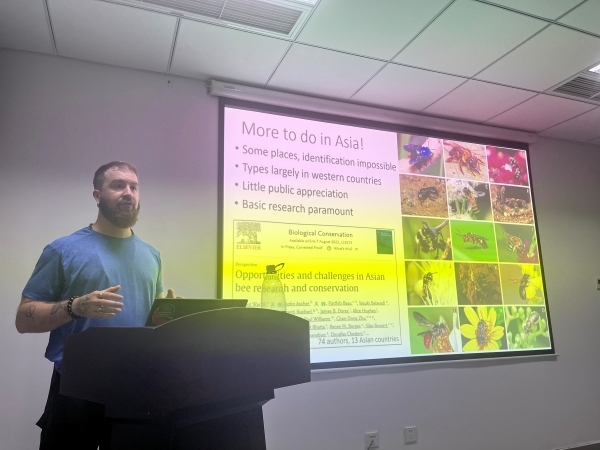
My PIFI visit was split into two trips of about one month each. The first trip took place in March and I spent most of my time in Beijing. There, I joined the MultiTroph meeting held between Chinese and German collaborators working at the BEF-China site in Xingangshan, Jiangxi province. Over the course of several days, colleagues from both sides presented their research and future plans. Alongside these efforts, I also met with other colleagues at the Institute of Zoology about various other projects, as well as with collaborators from China Agricultural University, Capital Normal University, the Institute of Botany, and the Institute of Apicultural Research. Although the visit was largely constrained to Beijing, there were many things to keep me busy and it was an enjoyable trip overall.
The second PIFI trip in September involved much more travel and gave me many new perspectives on not just new environments in China, but also on Chinese culture. I started in Beijing at the Institute of Zoology, hosted again by the lab of Chao-Dong Zhu, where many meetings were had once more. But within a week, it was time for the first plane ride, and I made my way to tropical Xishuangbanna where I gave a talk at Xishuangbanna Tropical Botanical Garden, hosted by Akihiro Nakamura. It was great to see the rainforest again and to sample a variety of insect-based dishes from the local Dai food culture.
From Xishuangbanna, I visited the Wuhan Botanical Garden, hosted there for a talk by Zhong-Ming Ye, Huan Liang, and Chun-Feng Yang. During this stay, we also visited Shennongjia alongside another visiting collaborator, Wenda Cheng of Sun Yat-Sen University. I hadn’t yet spent much time in the mountains of Central China, so it was very nice to visit these unique habitats, although it was sadly a little late in the season for bees. Alongside discussions and some hiking, we also visited Shennong Temple to learn more about Chinese history, before we all returned to Wuhan and then I returned to Beijing.
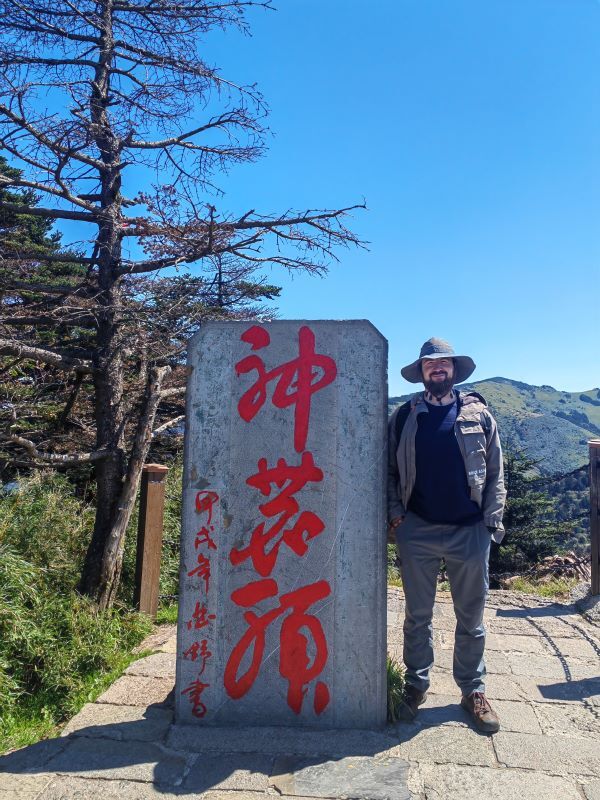
I took advantage of the October holiday to do some additional travel. From Beijing, I traveled to both Nanjing and Shanghai, mixing some remote work with sightseeing, as I’d somehow never yet traveled to these two iconic cities. It was great to finally experience these areas, and I enjoyed my time in both greatly. Tangshan near Nanjing was a special highlight, hosting some of the best hot springs I’ve ever been to (this means a lot, since just prior to this visit I had been to Kinosaki Onsen in Japan, a famous hot spring destination). After some relaxing there, I was ready for the final two weeks of my trip to China.
After yet another brief stopover in Beijing, I then traveled to Sichuan to give a talk at the Chengdu Institute of Biology, hosted there by Ming-Qiang Wang. Having both worked in the lab of Chao-Dong Zhu and as fellow members of the BEF-China project, we’ve had many prior academic exchanges and both look forward to many more. I first traveled to Mountain Emei with him the day before my talk, where we hiked up the mountain to the temple on top, enjoying the view and many discussions about not just science but also Chinese culture and history. With such a long history, it seems that there’s always more to learn. I was also impressed by Chengdu; as the “City in a Garden,” it well exemplified the Chinese concept of ecological civilization, with a great deal of green space throughout, complementing the vibrant discussions I had at the Chengdu Institute of Biology.
From Chengdu, Ming-Qiang and I traveled together to the Entomological Society of China’s 80th annual meeting in Chongqing. Ahead of time, we were first hosted for discussions by Dunyuan Huang at Chongqing Normal University, before I gave another talk at the meeting itself. All of my talks on this trip centered on my distributional work on bees and more broadly insects, as well as on conservation. I strongly emphasized the key role China and other countries in Asia will have in building the data and methodological foundations for future global studies.
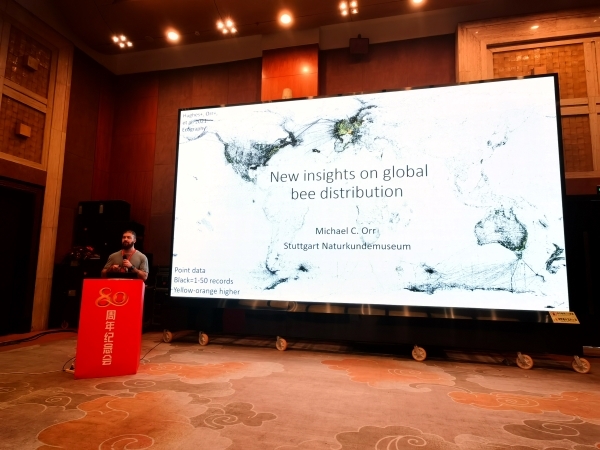
Following the conference, there was another symposium at Southwest University, where we were hosted by Zong-Qing Wang, and I gave another talk. There were again many discussions, and it proved an exciting and productive way to spend my last day in China. These two visits funded by the PIFI were a terrific reminder of all the opportunities for research in China, and I can’t wait for my next visit.